
 +1 (604) 554-0962
Basement and Secondary Suite Rules by City (Lower Mainland)
Suite and basement rules still differ from city to city across the Lower Mainland: which zones allow a suite, how many, registration, parking, and when finishing a basement needs a permit. Here is what the 17 communities we serve publish, with the source for every rule.
October 11, 2026 · 20 min read
When the Province introduced its small-scale, multi-unit housing legislation in November 2023, it said the legislation and its regulations would permit one secondary suite or one laneway home in all communities throughout BC (BC Gov News, Office of the Premier, checked 11 October 2026). That opened the door in many neighbourhoods, but it did not make the rules the same everywhere. The 17 communities below still publish different rules on which zones allow a suite, how many suites a house can have, whether a suite must be registered, how much parking it needs, and which basement work needs a building permit.
This guide collects what each city we serve publishes on its own website. Every rule names its source, and each city section links to the authority’s own page. The city rules were first checked on 22 September 2026 and again on 11 October 2026; a few extra rules added on 11 October 2026 are marked with that date. Rules change, so treat this as a starting point and confirm with the city before you design anything. For what a suite costs and the steps to make one legal, see our legal basement suite guide.
The short answer
- Where suites are allowed: some cities allow a suite in most single-family or single detached homes (Coquitlam, New Westminster, Delta and the District of North Vancouver; the last two checked 11 October 2026), in every single-detached zone (Port Moody) or in any single detached dwelling, though not below the flood construction level (Chilliwack). Others name specific zones (Burnaby, Port Coquitlam) or accept a suite only where the zoning bylaw permits one (Abbotsford).
- How many: Vancouver, Richmond, Coquitlam and White Rock each allow one secondary suite per house.
- Permits: each city section below lists the work its authority says needs a permit, and eight of the cities name finishing a basement or an unfinished area on their permit list.
- Registration and licences: Surrey, Pitt Meadows and White Rock require a suite to be registered. Port Coquitlam, Port Moody and Pitt Meadows require the contractor to hold a city business licence.
- Electrical and gas: most cities send you to Technical Safety BC. Vancouver, Burnaby, Maple Ridge and both North Vancouvers issue their own electrical and natural gas permits (gas within the province’s pressure and load limits); Surrey issues electrical permits and Richmond natural gas permits.
Finishing a basement vs creating a legal suite
A finished basement is more living space for your own household: a rec room, a bedroom, an office, perhaps a bathroom. A secondary suite is a second home inside the house. Coquitlam describes it as a self-contained living unit within a single detached home, complete with a kitchen, a bathroom and sleeping accommodation (City of Coquitlam, checked 11 October 2026).
Both usually need a building permit. Richmond, Surrey, Delta, Port Coquitlam, Coquitlam, the Township of Langley, Mission and Chilliwack name finishing a basement (or an unfinished area) on their permit lists, and the other cities list the renovation or alteration work that needs a permit, so ask yours how its list applies to your basement. A suite adds two more tests: the zoning has to allow it, and the space has to meet the BC Building Code’s requirements for a second dwelling. Richmond, for example, says a suite is legal only once it has been inspected and upgraded to the BC Building Code (City of Richmond). Adding a kitchen to a finished basement does not make it a legal suite.
If you are finishing a basement now and might add a suite later, New Westminster lists work that makes a future suite easier: hard-wired smoke alarms interconnected with the rest of the house, separate heating for the future suite area instead of shared forced-air ducts, fire-rated drywall on the ceiling and around a gas furnace room, fire-rated self-closing doors between the two areas, and bedroom windows large enough to get out through (City of New Westminster, checked 11 October 2026). Ask your own city which of these it expects.
Suite and basement rules, city by city
Each city below lists the rules its authorities publish, with the source named after each one. Two kinds of permit run side by side: the building permit from the city, and electrical and gas permits, which come from Technical Safety BC unless the city issues its own. Always confirm with the city before you plan: each section links the authority’s page and our renovation page for that city.
Vancouver
- Suites: allowed, but the Zoning and Development By-law permits only one secondary suite per single-family home (source: City of Vancouver)
- Permit generally needed for: moving interior walls or existing plumbing, electrical or gas lines, and adding a secondary suite (source: City of Vancouver)
- No permit for: replacing fixtures, cabinets or flooring, painting, and minor non-structural exterior repairs (source: City of Vancouver)
- Electrical and gas: the City issues its own electrical permits, and its own gas permits for fully detached homes on one meter at 2 psig or less and for other buildings at 2 psig or less up to 120 kW; an owner who lives in a detached home may do their own electrical work without a licensed contractor only if all six of the City’s conditions are met, among them no secondary suite, no part of the home rented out and a service of no more than 200 amps (source: City of Vancouver)
- Drawings: the full package in the City’s Addition/Renovation Permit Application Submission Checklist (source: City of Vancouver)
Confirm with: City of Vancouver, 3-1-1 (within Vancouver) / 604-873-7000 (from outside Vancouver). Our city page: renovations in Vancouver.
Burnaby
- Suites: allowed only within a single-family home, duplex (side-by-side or front-to-back, never one unit above the other), multiplex or rowhouse in the R1, A1, A2, A3 and RM6 zones (source: City of Burnaby)
- Permit needed for: any excavation, erection, enlargement, alteration or removal of a building or structure, including accessory buildings (source: City of Burnaby)
- No permit for: replacing fixtures, cabinets or flooring, interior painting, and minor non-structural exterior repairs (source: City of Burnaby)
- Electrical and gas: Burnaby issues its own electrical permits, and natural gas permits within the province’s limits (a fully detached house on one meter at 2 psi or less, or another building at 2 psi or less up to 120 kW); propane and other gases stay with Technical Safety BC (source: Technical Safety BC)
Confirm with: City of Burnaby, 604-294-7130. Our city page: renovations in Burnaby.
New Westminster
- Suites: permitted in most single detached houses, subject to the Zoning Bylaw and BC Building Code (source: City of New Westminster)
- Permit needed for: renovating, adding onto or building a new detached dwelling (source: City of New Westminster)
- Electrical and gas: issued by Technical Safety BC, not the City (source: Technical Safety BC)
- Plumbing: the City’s own Plumbing Department issues plumbing permits (source: City of New Westminster)
Confirm with: City of New Westminster, 604-527-4580. Our city page: renovations in New Westminster.
North Vancouver (City and District)
North Vancouver is two municipalities with separate building departments, and the address decides which one issues your permit.
- Suites, City of North Vancouver: permitted in new and existing single-family homes and duplexes, under the Zoning Bylaw and BC Building Code (source: City of North Vancouver)
- Suites, District of North Vancouver: allowed in single-family homes, with some exceptions (source: District of North Vancouver)
- Permit needed for (District): altering a house, building an addition or creating a secondary suite (source: District of North Vancouver)
- Electrical and gas: the City and the District each issue and inspect their own electrical permits, and natural gas permits within the province’s pressure and load limits; propane and other gases stay with Technical Safety BC (source: Technical Safety BC)
- Homeowner permits (District): an owner-occupant of a detached house with nothing attached to it may take out their own gas, plumbing or electrical permit if they do all the work themselves, with help only from an unpaid qualified person (source: District of North Vancouver)
Confirm with: District of North Vancouver, 604-990-2480; City of North Vancouver, 604-982-9675. Our city page: renovations in North Vancouver.
Richmond
- Suites: one secondary suite is allowed in a single-family detached home, and it must be inspected and upgraded to the BC Building Code to be legal (source: City of Richmond)
- Permit needed for: altering, renovating or repairing an existing building, or finishing an unfinished basement or rec room (source: City of Richmond)
- No permit for: cupboards, partial-height room dividers, painting, roofing repair and exterior finish repair (source: City of Richmond)
- Electrical and gas: the City issues its own natural gas permits, within the province’s pressure and load limits, but not electrical ones; electrical permits, propane and other gases go to Technical Safety BC (source: Technical Safety BC)
- How to apply: online through MyPermit, with a MyRichmond account (source: City of Richmond)
Confirm with: City of Richmond, 604-276-4118. Our city page: renovations in Richmond.
Delta
- Suites: every application to install a secondary suite needs a building permit issued through the Development Department (source: City of Delta)
- Permit needed for: altering or renovating a home, finishing an unfinished basement, or adding a secondary suite (source: City of Delta)
- No permit for: painting, cupboards, partial-height room dividers, and roofing, siding or stucco repair (source: City of Delta)
- Electrical and gas: Technical Safety BC issues these permits, and Delta asks for proof of them at the framing inspection (source: City of Delta)
- How to apply: apply and pay on DeltaOnline, then upload plans to Delta’s ePlan portal (source: City of Delta)
Confirm with: City of Delta, 604-946-3380. Our city page: renovations in Delta.
Surrey
- Suites: permitted in single-family homes, duplexes, triplexes and fourplexes, and every suite must be registered (source: City of Surrey)
- Permit usually needed for: finishing a basement, additions and interior renovations (source: City of Surrey)
- No permit for: replacing flooring and minor exterior repairs (source: City of Surrey)
- Electrical: the City of Surrey issues the permit, to the homeowner or a licensed contractor (source: City of Surrey)
- Gas: Technical Safety BC issues the permit; owners of a strata, a duplex or a home business cannot take out a homeowner permit (source: Technical Safety BC)
- Drawings: site and floor plans and details, and sealed structural drawings may be required (source: City of Surrey)
Confirm with: City of Surrey, 604-591-4366. Our city page: renovations in Surrey.
White Rock
- Suites: no more than one secondary suite per dwelling unit, and it must be inspected and registered with the City (source: City of White Rock)
- Permit needed for: renovations to a single-family home, including adding a secondary suite (source: City of White Rock)
- The 50% rule: if the work is worth more than 50% of the building’s assessed value, the whole building must be brought up to current Code and bylaws (source: City of White Rock)
- Electrical and gas: handled by Technical Safety BC, not the City (source: City of White Rock)
- How to apply: book an intake appointment with a Building Official before you submit (source: City of White Rock)
Confirm with: City of White Rock, 604-541-2149. Our city page: renovations in White Rock.
Coquitlam
- Suites: permitted in most single-family homes; a home may not contain more than one secondary suite (source: City of Coquitlam)
- Permit needed for: basement finishing, major renovations, structural repairs and work affecting fire and life-safety systems (source: City of Coquitlam)
- Also a permit trigger: removing or replacing drywall, altering insulation or ventilation, or moving a window or door opening (source: City of Coquitlam)
- No permit for: re-roofing, re-cladding, and replacing cabinets or floor finishes (source: City of Coquitlam)
- Electrical and gas: Technical Safety BC issues these permits, not the City (source: City of Coquitlam)
Confirm with: City of Coquitlam, 604-927-3441. Our city page: renovations in Coquitlam.
Port Coquitlam
- Suites: permitted only in the RS-1, RS-2, RS-3 and RS-4 zones, and a suite is built under a Building Permit (source: City of Port Coquitlam)
- Permit needed for: removing or relocating interior walls, finishing a previously unfinished area such as a basement, or creating a secondary suite (source: City of Port Coquitlam)
- Electrical and gas: inspections are carried out by Technical Safety BC (the City’s page still calls it the BC Safety Authority), not City Hall (source: City of Port Coquitlam)
- Business licence: your builder needs a valid Port Coquitlam business licence before the permit can be issued (source: City of Port Coquitlam)
Confirm with: City of Port Coquitlam, 604-927-5444. Our city page: renovations in Port Coquitlam.
Port Moody
- Suites: permitted in every single-detached residential zone and in the City’s duplex zone (source: City of Port Moody)
- Permit needed for: renovating your current home, before any construction starts (source: City of Port Moody)
- Electrical and gas: the City does not issue these permits; homeowners go to Technical Safety BC (source: City of Port Moody)
- Business licence: any business operating in Port Moody must hold a valid Port Moody business licence (source: City of Port Moody)
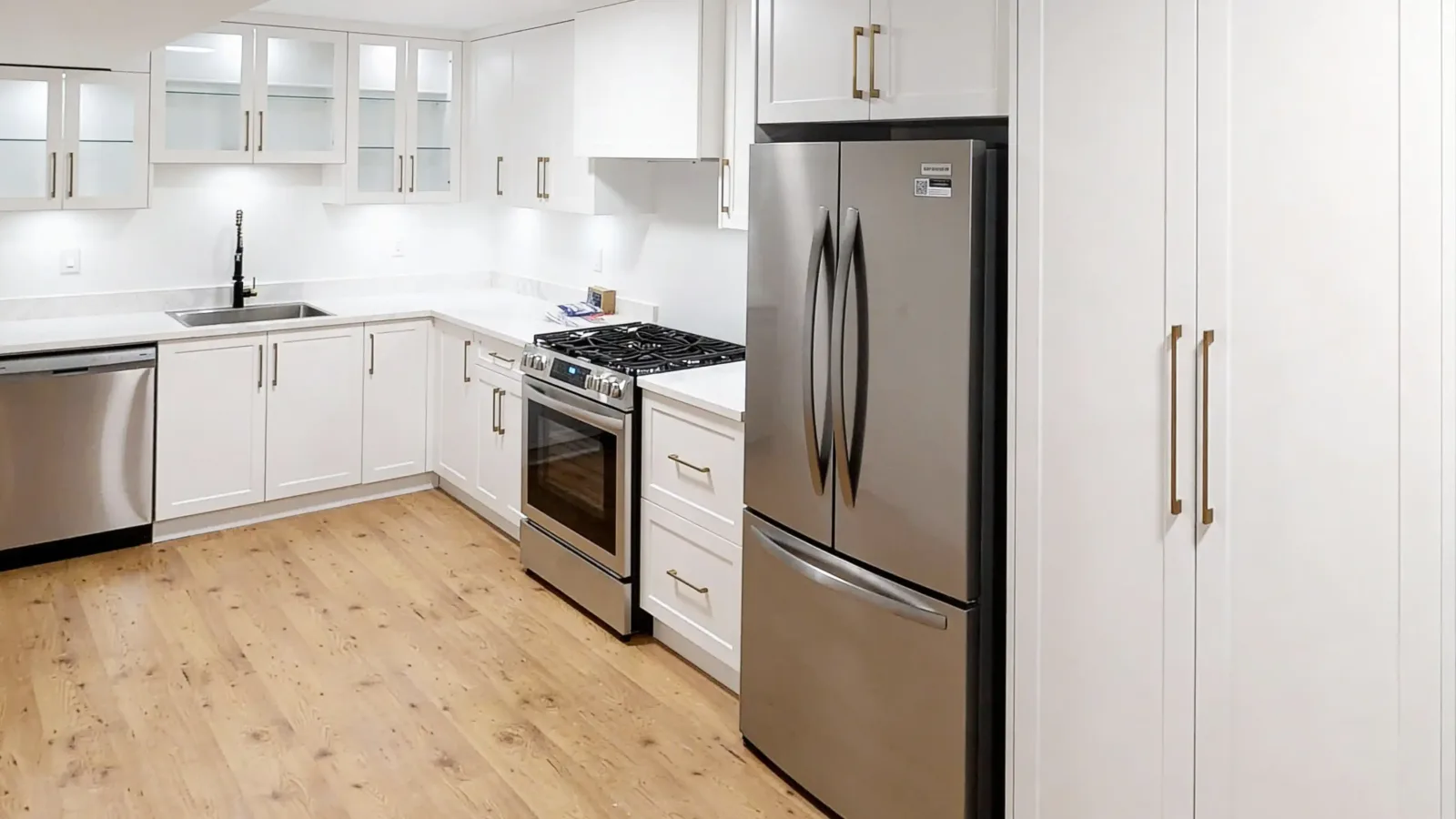
One of our own projects is here: a basement secondary suite in Port Moody with a modern kitchen.
Confirm with: City of Port Moody, 604-469-4534. Our city page: renovations in Port Moody.
Pitt Meadows
- Suites: permitted under Zoning Bylaw No. 2505, and every suite must be registered with the City (source: City of Pitt Meadows)
- Permit needed for: building, repairing or altering most buildings, including secondary suites and plumbing (source: City of Pitt Meadows)
- Electrical and gas: the City does not issue these permits; apply to Technical Safety BC (source: City of Pitt Meadows)
- Business licence: contractors and trades based elsewhere but working in Pitt Meadows need a City business licence too (source: City of Pitt Meadows)
Confirm with: City of Pitt Meadows, 604-465-2428. Our city page: renovations in Pitt Meadows.
Maple Ridge
- Permit needed for: building, remodelling, repairing, demolishing or moving any structure over 10 m² (107 sq. ft.), with a Home Improvement Building Permit (source: City of Maple Ridge)
- Rules that apply: the BC Building Code and the Maple Ridge Building and Zoning Bylaws (source: City of Maple Ridge)
- Electrical and gas: the City issues its own electrical permits, and natural gas permits within the province’s pressure and load limits; propane and other gases stay with Technical Safety BC (source: Technical Safety BC)
- Before work starts: construction may not start until the permit is issued (source: City of Maple Ridge)
The Maple Ridge pages we checked do not set out where a suite is allowed, so ask the City about the zoning for your property first.
Confirm with: City of Maple Ridge, 604-467-7311. Our city page: renovations in Maple Ridge.
Langley (Township and City)
Langley is two municipalities. The facts below are the Township of Langley’s; the smaller City of Langley runs its own Building Division (604-514-2804) for the addresses inside its boundary.
- Suites: every secondary suite needs a building permit and must meet municipal bylaws and provincial health and safety standards (source: Township of Langley)
- Permit needed for: altering, repairing, renovating or adding to a building, finishing a basement, or building a secondary suite (source: Township of Langley)
- Electrical and gas: not issued by the Township; apply to Technical Safety BC for both (source: Township of Langley)
- How to apply: select building permit applications can now be submitted online, and paper applications are no longer accepted where digital submission is available (source: Township of Langley)
Confirm with: Township of Langley, 604-533-6018. Our city page: renovations in Langley.
Abbotsford
- Suites: only where the Zoning Bylaw permits a suite on that property; otherwise the application cannot be processed (source: City of Abbotsford)
- Permit needed for: a kitchen or bath renovation that adds, removes or alters a wall (source: City of Abbotsford)
- No permit for: work limited to paint, finished flooring and cabinets (source: City of Abbotsford)
- Plumbing: in a kitchen or bath renovation, a City plumbing permit when a fixture is added, altered or relocated (source: City of Abbotsford)
- Electrical and gas: provincially regulated; permits come from Technical Safety BC (source: City of Abbotsford)
Confirm with: City of Abbotsford, 604-864-5525. Our city page: renovations in Abbotsford.
Mission
- Suites: the City’s suite checklist asks for drawings showing fire and sound separations, and for three off-street parking spaces in total (two for the main home, one for the suite) (source: City of Mission)
- Permit needed for: finishing a basement, creating a new room, larger openings in exterior walls, or installing a secondary suite (source: City of Mission)
- No permit for: roofing, cladding, painting, flooring and minor plumbing repairs (source: City of Mission)
- Electrical and gas: obtained from Technical Safety BC, not the City (source: City of Mission)
Confirm with: City of Mission, 604-820-3726. Our city page: renovations in Mission.
Chilliwack
- Suites: allowed in any single detached dwelling regardless of zone, built with a building permit and meeting the BC Building and Fire Code and current flood protection requirements; new suites are not permitted below the flood construction level (source: City of Chilliwack)
- Permit needed for: structural changes or repairs, and improving unfinished areas of a home (source: City of Chilliwack)
- No permit for: non-structural repair and maintenance of lawfully conforming structures on a lot zoned for single-family use (source: City of Chilliwack)
- Electrical and gas: Chilliwack is not one of the municipalities delegated to issue them, so they come from Technical Safety BC (source: Technical Safety BC)
Confirm with: City of Chilliwack, 604-793-2905. Our city page: renovations in Chilliwack.
The rules side by side
- One suite per house: Vancouver, Richmond, Coquitlam and White Rock.
- Suites in specific zones only: Burnaby (R1, A1, A2, A3 and RM6), Port Coquitlam (RS-1 to RS-4) and Abbotsford (where the zoning bylaw permits a suite on that property).
- Suites in most or all single-detached homes: Port Moody (every single-detached zone, plus its duplex zone), Chilliwack (any single detached dwelling, though not below the flood construction level), and New Westminster, Coquitlam, Delta and the District of North Vancouver (most single detached or single-family homes; Delta and the District checked 11 October 2026).
- Finishing a basement or an unfinished area named on the permit list: Richmond, Surrey, Delta, Port Coquitlam, Coquitlam, the Township of Langley, Mission and Chilliwack.
- Suite registration: Surrey, Pitt Meadows and White Rock; the District of North Vancouver also asks every home with a suite to register it, for utility charges (District of North Vancouver, checked 11 October 2026).
- City business licence for your contractor: Port Coquitlam, Port Moody and Pitt Meadows (including contractors based elsewhere).
- City issues electrical and/or gas permits: Vancouver, Burnaby, Maple Ridge and the City and District of North Vancouver (both), Surrey (electrical) and Richmond (gas); a city’s gas permits cover natural gas within the province’s pressure and load limits, and propane stays with Technical Safety BC. Everywhere else, Technical Safety BC.
- Parking for a suite: Mission asks for three off-street spaces in total (City of Mission). Coquitlam’s June 2021 suite brochure, which its Secondary Suites page still links, asks for one extra space on top of the two the main home needs; Delta asks for one on-site space, except for suites under 33 m² or within 400 m of frequent transit on Scott Road; White Rock asks for one additional on-site space; and the District of North Vancouver lists three off-street spaces on the property among its conditions (each city’s own page, checked 11 October 2026).
Before you start: always confirm with the city
Every rule in this guide comes from the authority’s own website: the city sections were first checked on 22 September 2026 and again on 11 October 2026, and the rules marked 11 October 2026 were read on that date. Bylaws change, and a single property can carry its own limits. Coquitlam’s suite brochure (June 2021, still linked from its Secondary Suites page), for example, says the City will not permit a suite where a restrictive covenant on title prohibits it (City of Coquitlam, checked 11 October 2026). Before you design a suite or finish a basement, check the zoning for your address and the current permit requirements with the authority linked in your city’s section.
Frequently asked questions
Do I need a permit to finish a basement?
In most cases, yes. Richmond, Surrey, Delta, Port Coquitlam, Coquitlam, the Township of Langley, Mission and Chilliwack name finishing a basement or an unfinished area on their permit lists, and every other city in this guide lists the renovation or alteration work that needs a permit, so ask yours how its list applies. Many of them also list work that needs no permit, such as painting or replacing cabinets or flooring, though each city’s list differs. Electrical and gas work needs its own permit, from Technical Safety BC or, in a few cities, from the city itself.
Can I have two suites in one house?
Not where the city sets a limit. Vancouver, Richmond, Coquitlam and White Rock each allow one secondary suite per house, and Delta’s suite page says the same (City of Delta, checked 11 October 2026). Vancouver adds that a duplex may have two suites, but only one per primary dwelling unit and not in every zone, and that a third suite is not allowed (City of Vancouver, checked 11 October 2026). Surrey allows suites in single-family homes, duplexes, triplexes and fourplexes, or in a separate building on the same lot. A detached laneway or garden home is a different question with its own rules, so ask the city.
Can a secondary suite be stratified and sold separately?
No, in every city in this guide whose page addresses it. Vancouver, Coquitlam, Delta, New Westminster, the District of North Vancouver and White Rock each say a secondary suite cannot be strata-titled or stratified, and Delta, New Westminster and the District add that it cannot be sold separately from the house (each city’s own page, checked 11 October 2026).
Do I have to live in the house to have a suite?
It depends on the city, and most of the pages checked for this guide do not say. White Rock does: its secondary suite bulletin, amended in March 2025, says the property owner must reside in the primary residence (City of White Rock, checked 11 October 2026). The City of North Vancouver’s secondary suite bulletin, first issued in 2013 and last updated in 2017, says the owner must live in either the main home or the suite (City of North Vancouver, checked 11 October 2026); ask the City whether that still applies. Owner-occupancy also matters for trade permits: Vancouver lets an owner who lives in a detached house do their own electrical work only when, among other conditions, the house has no secondary suite and no part of it is rented out (City of Vancouver, checked 11 October 2026), and the District of North Vancouver’s homeowner permits exclude a house with a suite attached. Ask your city about its rule before you plan to rent out both units.
Planning a suite or a basement?
For what a suite costs, how financing works and the path to making one legal, read our guide to adding a legal basement suite in BC. To see a finished one, look at the basement secondary suite we built in Port Moody. When you are ready, our residential renovation team can check your basement against your city’s rules, prepare the drawings and handle the permit applications.
PCC Renovations Team
Renovation specialists
More articles
Adding a Legal Basement Suite in BC: Permits, Cost and Timeline (2026)
BC now allows secondary suites province-wide — but legal is…BC now allows secondary suites province-wide — but legal is the operative word. What a code-compliant basement suite costs in…BC now allows secondary suites province-wide — but legal is the operative word. What a code-compliant basement…
August 24, 2026 • 6 min
How Much Does a Bathroom Renovation Cost in Metro Vancouver? (2026 Guide)
What Metro Vancouver homeowners actually pay for bathroom…What Metro Vancouver homeowners actually pay for bathroom renovations in 2026 — powder rooms to full ensuites, the plumbing…What Metro Vancouver homeowners actually pay for bathroom renovations in 2026 — powder rooms to full ensuites, the…
August 24, 2026 • 4 min
How Much Does a Kitchen Renovation Cost in Metro Vancouver? A 2026 Price Guide
Realistic 2026 kitchen renovation budgets for Metro…Realistic 2026 kitchen renovation budgets for Metro Vancouver — what a refresh, a mid-range remodel and a custom kitchen…Realistic 2026 kitchen renovation budgets for Metro Vancouver — what a refresh, a mid-range remodel and a custom…
August 24, 2026 • 5 min

Let’s build a space you’ll love for years.
Book a free consultation with our renovation specialists and receive recommendations, to help you create a space that’s functional, beautiful, and built around your needs.